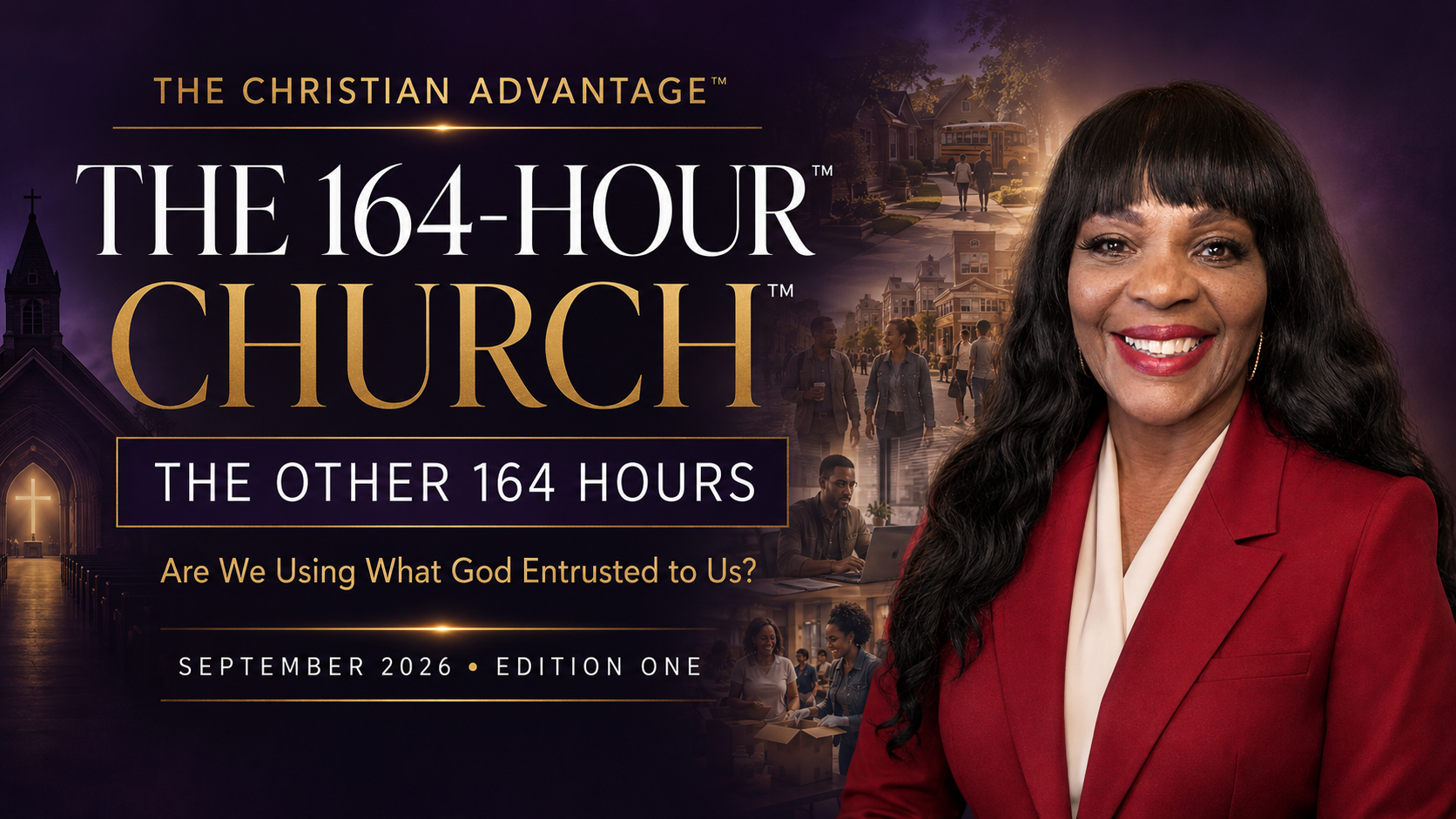
The 164-Hour Church™ • Edition 01 • September 2026
What Is Your Church Doing With the Other 164 Hours?
A practical invitation to see the church as a seven-day ministry, stewarding what God has already placed in the hands of His people.
By DrFaye Wilson
A leadership conversation for churches and community-minded ministry leaders. Read slowly. Discuss honestly. Begin with what is already present.
Sunday Morning Matters
Sunday morning matters. It is a sacred gathering, a place of worship, teaching, fellowship, prayer, and encouragement. It is where the people of God remember who they are and whose they are.
But Sunday morning is not the whole story of the church.
A week contains 168 hours. The phrase “the other 164 hours” is an illustrative framing device based on a hypothetical four-hour weekly church gathering. It is not a universal measurement. Churches may gather for more or less time, and many churches are already engaged in ministry throughout the week. Every church's schedule, ministry model, people, and available capacity will differ.
The question is not whether your church is active. The question is whether the activity is connected to the assets, people, and needs already in front of you.
The Church Is More Than a Sunday Destination
The church is a people before it is a place. A building may serve the mission, but the mission is carried by people who worship, work, learn, lead, serve, and care throughout the week.
That wider view changes the question. Instead of asking only, “What program should we start next?” church leaders can also ask, “What has God already entrusted to us, and how might it be stewarded faithfully?”
A classroom may be more than an empty room between services. A kitchen may be more than a Sunday-morning workspace. A parking lot, a van, a computer lab, a retired teacher, a business owner, a young adult, or a trusted relationship may all be part of the church's current capacity for service.
This is not a call to fill every hour. Rest, family, preparation, pastoral care, and quiet faithfulness are part of ministry too. It is a call to see the whole week with fresh eyes.
What God Has Already Placed in Our Hands
Many churches carry more capacity than they realize. The first step is not to announce a new initiative. The first step is to notice.
People
Teachers, nurses, tradespeople, counselors, business owners, technologists, artists, administrators, parents, seniors, young adults, and neighbors who bring lived experience and practical wisdom.
Places
Classrooms, fellowship halls, kitchens, offices, parking areas, outdoor space, and accessible meeting rooms that may be available at different times of the week.
Tools
Technology, transportation, communication channels, equipment, curriculum, relationships, and the ordinary systems that already help the congregation function.
Trust
The credibility built through consistent presence, pastoral care, prayer, listening, and relationships with families, schools, neighborhoods, and local organizations.
The work of stewardship is to connect those assets with a real need, a clear purpose, and a responsible rhythm. It is not to create activity for activity's sake.
Asset to Impact: Examples With Care
The following examples are illustrative only. They are conversation starters, not recommendations or promises.
| Asset already present | Possible stewardship conversation |
|---|---|
| Classrooms and patient teachers | Could the church host tutoring, reading support, or a study table in partnership with families or schools? |
| Technology and digital fluency | Could trusted volunteers offer basic digital literacy, device navigation, or online-safety education? |
| Business owners and professionals | Could members share general financial education, entrepreneurship lessons, career stories, or workplace readiness? |
| Kitchen, volunteers, and local relationships | Could the church support food-security efforts with an established community partner rather than duplicating an existing service? |
| Seniors and intergenerational wisdom | Could the church create a mentoring rhythm that connects experience, encouragement, and practical support across generations? |
| Transportation or accessible space | Could a carefully governed partnership help people reach an existing service, class, or community resource? |
Partnership Before Another Program
Before building something new, ask who is already doing it well.
Schools, nonprofits, businesses, libraries, public agencies, neighborhood groups, and other churches may already have experience, infrastructure, and relationships connected to the need you are trying to address. A thoughtful partnership can make the church's contribution more focused and more responsible.
Partnership is not a shortcut around accountability. It requires clarity about roles, decision-making, communication, screening, insurance, privacy, safeguarding, accessibility, and how concerns will be handled. A written agreement may be appropriate. So may a limited pilot with a clear review point.
References to Lifeway Research and Emmanuel Gospel Center belong in the wider conversation about church life, community presence, and ministry beyond a weekly gathering. They are included here as non-linked references only; this issue does not endorse or direct readers to an external resource.
The strongest partnership is not the one that makes the church look busiest. It is the one that helps the people being served receive thoughtful, trustworthy care.
Ministry Capacity Questions
Leaders may use these questions in prayer, staff discussion, a board conversation, or a listening session with the congregation.
- 01
What is already happening beyond Sunday?
Name the quiet, consistent work that is easy to overlook because it is not labeled as a program.
- 02
Which assets are available?
Consider people, places, tools, time, relationships, and trust. What is present, and what is genuinely available?
- 03
What need is actually being heard?
Listen before designing. Whose voice is missing? What would responsible service look like from their perspective?
- 04
What capacity can we sustain?
Consider leadership, volunteer energy, cost, safety, communication, space, and the effect on existing ministry.
- 05
Who is already doing this well?
Identify possible partners, referral pathways, and reasons to collaborate before creating a parallel program.
The 164-Hour Ministry Asset Review™
Use this five-question exercise to help a ministry team move from broad possibility to a responsible next conversation. Begin with what is true now, and invite the team to answer briefly, without trying to solve everything in the first sitting.
- What does our church already have? List people, spaces, tools, relationships, and practical knowledge.
- What are we hearing? Name the needs, hopes, and concerns that are being expressed by the people and communities connected to the church.
- What is our actual capacity? Consider time, leadership, volunteers, budget, training, facilities, safety, and sustainability.
- Who could help? Identify organizations or individuals already equipped to serve, and clarify what a healthy partnership would require.
- What is the next faithful step? Choose one small, observable step: listen, refer, document, schedule, pilot, partner, or pause.
The Christian Advantage Insight™
The Christian advantage is not that the church has to do everything. It is that the church can see people, resources, relationships, and responsibility through the lens of faithful stewardship. When we stop measuring ministry only by what is new, we may notice what God has already placed in our hands.
Carry Sunday forward
Let worship shape the way the church listens, serves, partners, teaches, and cares during the week.
Make capacity visible
Name the people and resources already contributing, then build rhythms that are clear, safe, and sustainable.
A Word About This Newsletter
The Christian Advantage™ is an editorial discussion for church and community leaders. It is designed to encourage thoughtful stewardship of existing people, places, tools, relationships, and trust. It is not a grant solicitation, grant application, financial product, or professional-advice service.
This issue intentionally keeps the focus on faithful stewardship of what God has already entrusted to the church. Any reference to The Fundability Institute™ is educational and does not imply that a review qualifies a church for grants, funding, revenue, or any guaranteed outcome.
Each church's calling, schedule, ministry model, governance, legal context, and available capacity will differ. The wisest next step may be a conversation, a referral, a partnership, a carefully bounded pilot, or a decision to wait.
Closing disclaimer
This newsletter is provided for general educational and spiritual purposes only. It is an editorial discussion and does not constitute legal, financial, tax, medical, mental-health, safeguarding, grant-writing, or other professional advice. Examples are illustrative only; churches should evaluate their own legal, operational, safety, insurance, privacy, and partnership requirements and consult qualified professionals as appropriate. No specific ministry, financial, organizational, or community outcome is promised or guaranteed.