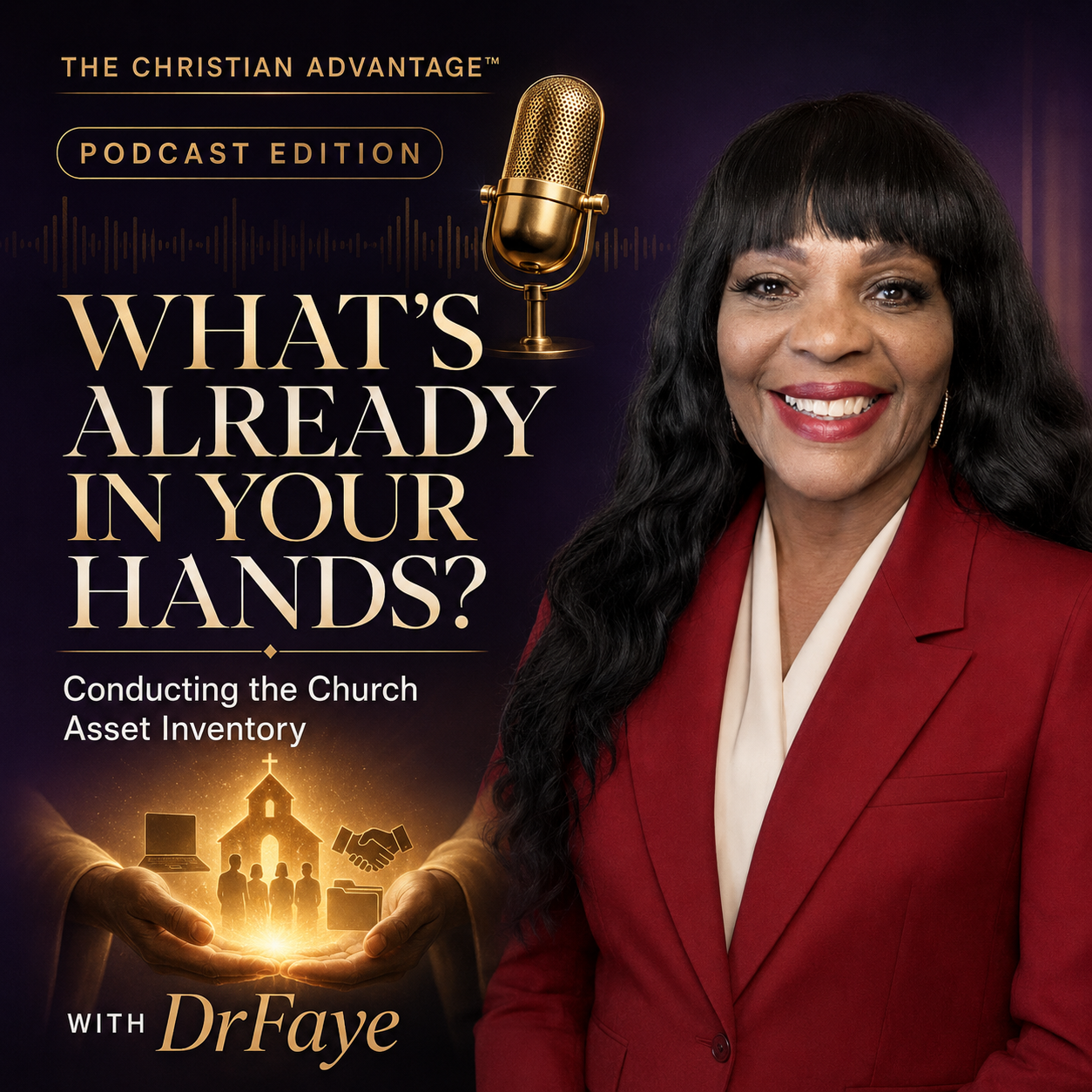
The 164-Hour Church™ • Edition 02 • September 2026
What Has God Already Placed in Your Hands?
Before asking God for more, take inventory of what He has already entrusted to you. A practical framework for conducting the Church Asset Inventory across seven lenses.
By DrFaye Wilson

Before a church asks for more money, more volunteers, more property, or another program, it should first examine what God has already placed within the ministry. Capacity is often present before it is recognized.
God Often Begins With What Is Present
This week, we are moving from awareness to inventory. We are looking carefully at the people, property, knowledge, relationships, tools, trust, and testimony already in our hands.
There is a moment in Second Kings when a widow is facing the loss of everything. Her need is urgent, her resources appear exhausted, and the future of her household is at risk.
Elisha does not begin by asking what she lacks. He asks a different question:
What hast thou in the house? — 2 Kings 4:2
Her answer sounds small: a pot of oil. Yet the miracle begins with the very thing she nearly dismissed.
Churches can do the same. We become so aware of what we do not have that we overlook what is already present. We see a small congregation instead of a concentration of lived experience. We see an old building instead of classrooms, meeting space, a kitchen, parking, land, and community access. We see ordinary members instead of educators, caregivers, business owners, tradespeople, organizers, communicators, and trusted neighbors.
What looks ordinary may be the starting point of extraordinary ministry.
An inventory is not merely an administrative exercise. It is an act of stewardship. We cannot faithfully deploy what we have never taken time to recognize.
Your Church Has More Than a Budget
When leaders hear the word asset, many think first about money. Financial resources matter, but they represent only one part of ministry capacity.
A church asset is anything God has entrusted to the ministry that can be responsibly aligned with its assignment.
Your balance sheet may not reveal your ministry’s greatest wealth.
The member who understands grant compliance is an asset. The retired principal who knows the school system is an asset. The contractor who can evaluate a facility is an asset. The church van, commercial kitchen, fellowship hall, mailing list, website, neighborhood relationships, reputation, and history of showing up are all assets.
Some assets are tangible. Others are relational, intellectual, spiritual, or reputational. All of them deserve thoughtful stewardship.
Before asking God for more, take inventory of what He has already entrusted to you.
The Seven-Part Church Asset Inventory
Gather a small, representative leadership team and examine the ministry through seven lenses.
- 01
People and Expertise
Professions, trades, education, lived experience, spiritual gifts, leadership ability, languages, and community knowledge.
- 02
Property and Space
Sanctuary, classrooms, offices, kitchen, fellowship hall, parking, land, storage, and outdoor gathering areas.
- 03
Equipment and Transportation
Vans, buses, tools, furniture, kitchen equipment, sound systems, computers, projectors, and supplies.
- 04
Technology and Communication
Website, email list, social platforms, streaming tools, internet access, media equipment, and communication skills.
- 05
Relationships and Partnerships
Schools, businesses, nonprofits, healthcare providers, civic leaders, funders, other churches, and neighborhood advocates.
- 06
Community Knowledge and Trust
Credibility, local history, cultural understanding, access to families, and the confidence people place in the ministry.
- 07
Stories, Outcomes, and Evidence
Testimonies, participation records, photographs, partnerships, results, and examples of lives or conditions changed.
Look Beyond the Obvious
A useful inventory requires more than one person completing a form from memory. Different people see different assets.
- 01
Invite the right voices
Include pastoral leadership, ministry leaders, trustees, administrators, younger adults, longtime members, and people who understand the community.
- 02
Walk the property
Visit every room, storage area, vehicle, technology station, outdoor space, and piece of major equipment. Record condition, accessibility, and current use.
- 03
Ask members what they know
Do not ask only where they volunteer. Ask what they have learned through work, family, service, hardship, education, and life.
- 04
Map relationships
Identify who already has trusted access to schools, employers, local government, healthcare, funders, civic organizations, and neighborhood groups.
- 05
Gather evidence
Collect photographs, attendance records, testimonials, partner letters, program summaries, and outcomes that show what the church has already accomplished.
Inventory before strategy. Clarity before expansion.
Inventory Does Not Mean Immediate Activation
Discovering an asset does not mean the church should immediately launch a program around it.
A room may require repairs. A vehicle may need an insurance review. A member may have expertise but no desire to lead. A partnership may require a written agreement. Technology may exist without anyone assigned to maintain it.
The inventory tells you what is present. Discernment determines what is ready, responsible, and aligned.
| Lens | Question |
|---|---|
| ALIGNED | Does this asset support the church’s mission and a real community need? |
| AVAILABLE | Is it genuinely accessible, or does it exist only on paper? |
| READY | Is it safe, functional, insured, documented, and properly led? |
| SUSTAINABLE | Can the church support its use without exhausting people or destabilizing current ministry? |
Wise stewardship protects people, property, reputation, and the assignment. The goal is not to use everything. The goal is to understand everything so leadership can make sound decisions.
What Becomes Possible When Capacity Is Visible
Once a church can clearly name what it has, new possibilities emerge.
Members
Begin to see their professional knowledge and lived experience as ministry capacity.
Leaders
Can match real community needs with existing strengths instead of copying another church’s program.
Buildings and equipment
Can be evaluated for responsible use throughout the week.
Potential partners
Can quickly understand what the church contributes to a collaboration.
Gaps
Become clearer, making future fundraising and grant requests more specific and credible.
Stories and evidence
Can be documented before valuable history is lost.
Funders do not create ministry capacity. They invest more confidently when responsible leadership, credible evidence, usable assets, and a clear assignment are already visible.
The Christian Advantage™ Takeaway
The first step toward activating greater ministry capacity is not acquiring more. It is seeing clearly, stewarding wisely, and documenting faithfully what God has already placed in your hands.
Conduct the First Inventory Conversation
Gather your leadership team this week and ask:
- What people, property, knowledge, equipment, relationships, and trust has God already entrusted to this church?
- Which of these assets are currently active, underused, unavailable, or not yet ready?
- What is one asset we should examine more carefully before our next leadership meeting?
Do not begin by deciding what to launch. Begin by making what is present visible.
About DrFaye
DrFaye is Chief Fundability Officer of The Fundability Institute™, host of Around Town with DrFaye and Faith Alive in 5. Contact: TheFundabilityInstitute.com | AroundTown.DrFaye.com | FaithAlivein5.com | compliance@drfaye.com