The 164-Hour Church™ • Edition 03 • September 2026
Your Building Is More Than a Building
A church building is property entrusted to a ministry for the fulfillment of an assignment. How to turn underused space into faithful, safe, and sustainable community capacity.
By DrFaye Wilson
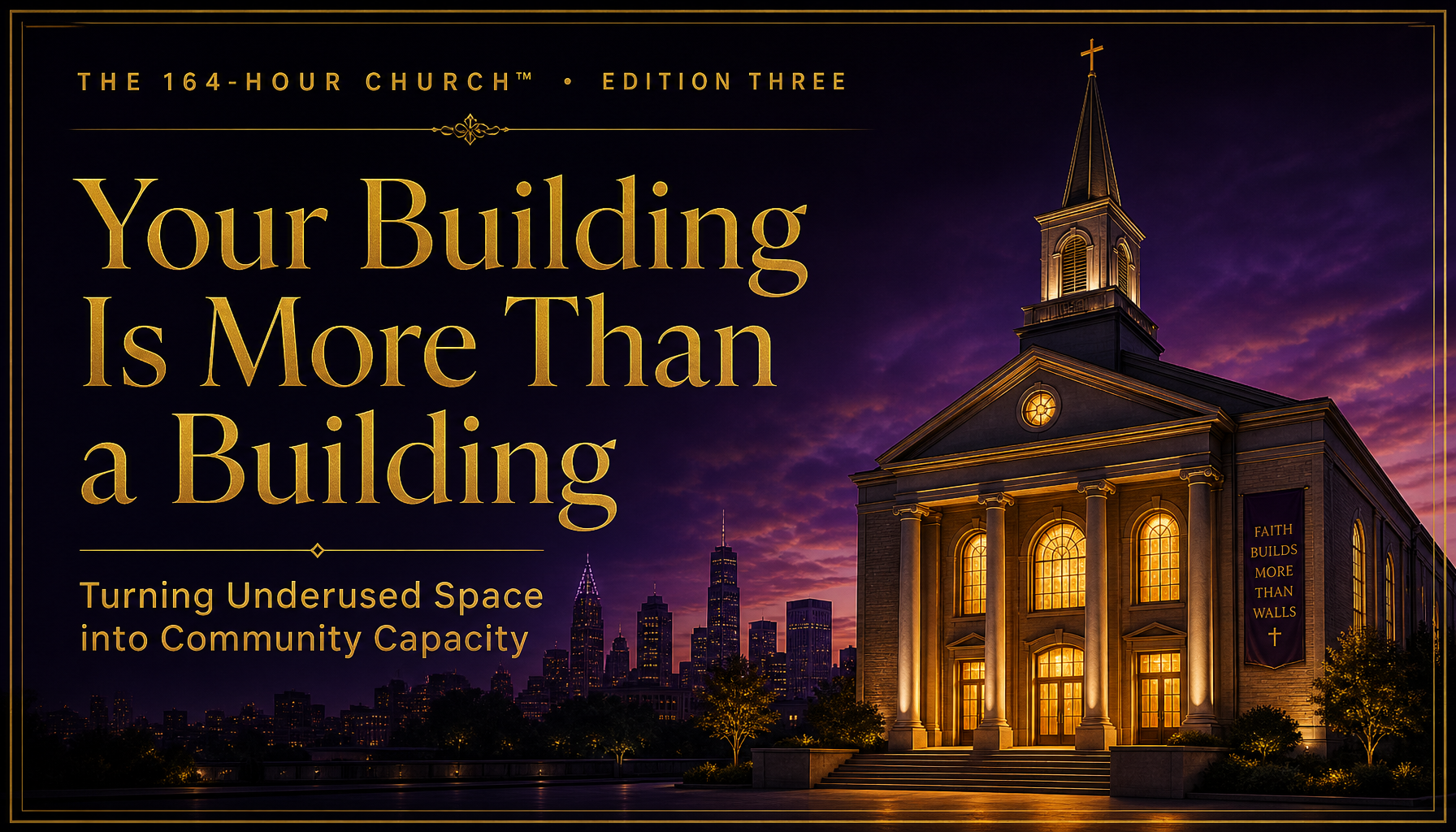
A church building is more than a place to gather on Sunday. It is property entrusted to a ministry for the fulfillment of an assignment. When leaders see the facility only as a sanctuary, they may overlook its weekday capacity.
The Question Is Faithfulness
The question is not how quickly we can fill every room. The question is how faithfully, safely, and sustainably our space can serve God's purpose and a real community need.
The Building Is Part of the Assignment
Church buildings hold sacred memories. They are places where people worship, pray, grieve, celebrate, learn, and encounter God together. That spiritual significance should never be diminished.
But honoring the sanctuary does not require ignoring the rest of the facility. Classrooms, kitchens, fellowship halls, offices, parking areas, land, technology, and gathering spaces may carry weekday possibilities that leadership has never fully examined.
Faithfulness is not only about protecting what God has provided. It is also about understanding its purpose, maintaining it responsibly, and deploying it wisely.
The question is not whether every room must remain busy. The question is whether the ministry has prayerfully examined what its property could contribute to the assignment.
A church building should never be reduced to square footage. It represents sacrifice, history, community trust, and Kingdom responsibility. Yet many facilities are evaluated only by what happens inside them during scheduled worship. That view can hide capacity in plain sight.
A building can be preserved and still be underused.
A classroom could support tutoring or digital-literacy instruction. A fellowship hall could host workforce development, grief support, health education, or leadership training. A kitchen could strengthen a food partnership. Parking space could support community events or mobile services. An office could provide confidential meeting space for a trusted partner.
This does not mean the church must operate every service itself. Sometimes the wisest use of space is a carefully structured partnership with an organization that already has the expertise, staffing, insurance, and systems to serve well.
Your building is not merely where ministry happens. Your building may be part of how ministry happens.
From Sacred Property to Stewarded Capacity
Before announcing a new use, walk through the property with leaders who understand ministry, operations, safety, finance, and the community. Examine these seven areas.
- 01
Mission Alignment
What part of the church's assignment could this space responsibly support?
- 02
Physical Condition
What repairs, maintenance, cleaning, accessibility improvements, or inspections are needed?
- 03
Current Use
When is the space occupied, reserved, unavailable, or sitting unused?
- 04
Access and Security
Who would enter the building, which areas would be accessible, and how would people and property be protected?
- 05
Insurance and Compliance
What policies, permits, occupancy rules, background checks, agreements, or professional guidance are required?
- 06
Leadership and Operations
Who will open, close, supervise, schedule, clean, communicate, and resolve problems?
- 07
True Cost
What will utilities, staffing, supplies, maintenance, technology, security, and administration actually require?
Stewardship is not filling space. Stewardship is aligning space with purpose.
Begin With Need, Not an Empty Room
An empty room is not a ministry strategy. A real community need, matched with mission and capacity, can become one.
Before deciding how to use space, listen beyond the church walls. Talk with families, schools, employers, healthcare providers, nonprofit leaders, civic organizations, and other ministries. Learn which needs are real, which services already exist, and where access is limited.
- 01
Name the need
What is happening in the community that deserves a thoughtful response?
- 02
Confirm the fit
Does responding to this need align with the church's mission, values, and available capacity?
- 03
Identify the right leader
Who possesses the competence, character, time, and authority to guide the work?
- 04
Consider partnership first
Is another trusted organization already equipped to deliver the service while the church contributes space, relationships, or access?
- 05
Begin with a pilot
Can the idea be tested for a defined period before the church makes a long-term commitment?
A room is not truly available until leadership understands what responsible use requires.
Conduct a Responsible Facility Review
Good intentions do not remove operational responsibility. When a church opens its property, it also accepts obligations connected to safety, supervision, scheduling, security, accessibility, insurance, documentation, and communication.
| Lens | Question |
|---|---|
| PURPOSE | Is the proposed use clearly connected to mission and community need? |
| PEOPLE | Are qualified leaders, volunteers, partners, and safeguards in place? |
| PROPERTY | Is the space safe, accessible, maintained, insured, and suitable? |
| PROCESS | Are scheduling, agreements, costs, responsibilities, and reporting documented? |
A simple written agreement should identify who is responsible for access, supervision, damage, cleaning, insurance, communication, data, and outcomes. Professional legal, insurance, building, and safety guidance should be obtained when appropriate.
Do not build a program around an empty room. Build a responsible response around a confirmed need.
Open the Door With Wisdom
When property is aligned with mission and managed responsibly, the church can become more visible, useful, and trusted throughout the week.
Children
May gain a safe place to learn and receive support.
Adults
May access training, technology, mentoring, or employment resources.
Families
May connect with health education, food assistance, grief support, or community services.
Local organizations
May find a credible partner with space and trusted relationships.
Church members
May discover meaningful assignments connected to their experience and gifts.
The ministry
May begin documenting participation, partnerships, outcomes, and community value.
Fundability grows when a church can demonstrate that its property is well maintained, responsibly governed, strategically used, properly documented, and connected to measurable community impact.
The Christian Advantage™ Takeaway
The goal is not simply to open the church. The goal is to serve people well while protecting the ministry's mission, people, property, and credibility.
Begin the Facility Conversation
Gather your leadership team this week and choose one space to examine. Do not promise a program. Begin with prayer, listening, inspection, and responsible planning.
- Which space in our facility sits underused during the week, and what could it responsibly contribute to the assignment?
- Which of the seven review areas — mission, condition, use, security, compliance, operations, and cost — do we understand least about that space?
- Who in our community should we listen to before deciding anything?
About DrFaye
DrFaye is Chief Fundability Officer of The Fundability Institute™, host of Around Town with DrFaye and Faith Alive in 5. Contact: TheFundabilityInstitute.com | AroundTown.DrFaye.com | FaithAlivein5.com | compliance@drfaye.com